
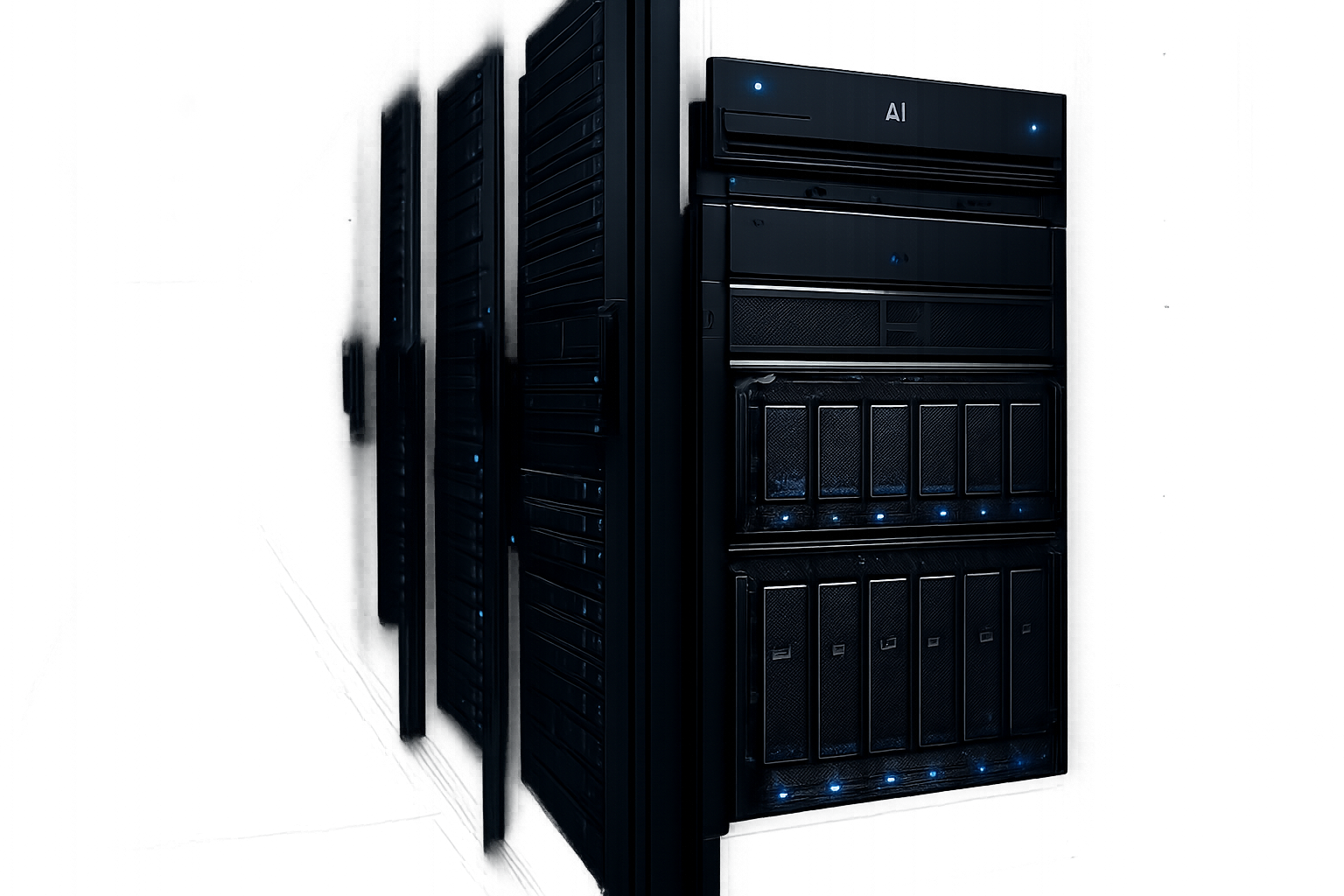
AI-ready platforms
Validated for enterprise training and inference workloads.
OEM-backed systems
Sourced through leading OEM and infrastructure partners.
Consultation-led sourcing
Platform selection aligned to power, density, and deployment goals.
AI Servers
Source enterprise datacenter AI servers for model training, production inference, and high-density deployment with consultation-led alignment across platform, power, and rack design requirements.
AI-ready platforms
Validated for enterprise training and inference workloads.
OEM-backed systems
Sourced through leading OEM and infrastructure partners.
Consultation-led sourcing
Platform selection aligned to power, density, and deployment goals.
OEM ecosystem
LXK CAPITAL sources across established OEM channels so enterprise buyers can evaluate the right compute platform with confidence.
Standard specification matrix
Condensed technical matrix across seven NVIDIA platform classes, aligned to standard procurement dimensions for silicon, node design, fabric, I/O, and power planning.
| Specification dimension | NVIDIA Vera Rubin R200 | NVIDIA HGX H100 | NVIDIA HGX H200 | NVIDIA HGX B200 | NVIDIA HGX B300 | NVIDIA GB200 | NVIDIA GB300 |
|---|---|---|---|---|---|---|---|
| GPU Silicon & Architecture | |||||||
| Processor Model | Rubin-generation accelerator complex | H100 SXM accelerator | H200 SXM accelerator | B200 SXM accelerator | B300 SXM accelerator | Grace Blackwell superchip platform | Grace Blackwell next-phase platform |
| Process Technology | Advanced multi-die process class (vendor release dependent) | TSMC 4N class | TSMC 4N class with updated memory stack | Blackwell-generation advanced node class | Blackwell-generation advanced node class | Advanced node mix across Grace + Blackwell dies | Next-phase advanced node mix across Grace + Blackwell dies |
| Transistor Count | Public class reference; final module totals by platform release | ~80B class GPU die reference | ~80B class GPU die reference with expanded memory subsystem | Blackwell class, vendor-disclosed module-level aggregate | Blackwell class, higher-bin module-level aggregate | Superchip aggregate count by NVIDIA reference design | Superchip aggregate count by next-phase reference design |
| Core Architecture | Rubin architecture class with rack-scale integration | Hopper architecture | Hopper architecture (memory-extended tier) | Blackwell architecture | Blackwell architecture (performance-extended tier) | Grace Blackwell coupled CPU-GPU architecture | Grace Blackwell coupled CPU-GPU architecture (next phase) |
| Thermal Design Power (TDP) | Liquid-first high-density power envelope; SKU dependent | Up to ~700W per SXM GPU (OEM profile dependent) | ~700W class per SXM GPU (OEM profile dependent) | High-power liquid-ready envelope; OEM tuned | High-power liquid-ready envelope; OEM tuned | Superchip liquid-cooled power class per rack reference | Superchip liquid-cooled power class per next-phase rack reference |
| GPU Memory | |||||||
| Memory Type & Capacity | HBM-class stacked memory; capacity by platform SKU | HBM3, 80GB class per GPU | HBM3e, 141GB class per GPU | HBM3e high-capacity class per GPU | HBM3e expanded-capacity class per GPU | HBM3e with coherent Grace memory domain | Expanded HBM class with coherent Grace memory domain |
| Memory Bandwidth | Multi-terabyte/s class target per accelerator complex | Up to ~3.35 TB/s class per GPU | Up to ~4.8 TB/s class per GPU | Multi-terabyte/s class Blackwell profile | Multi-terabyte/s class Blackwell profile (higher bin) | Platform-level aggregate memory bandwidth via superchip design | Higher platform-level aggregate bandwidth in next-phase design |
| Partitioning Support | Virtual partitioning expected via platform firmware stack | MIG-class partitioning support | MIG-class partitioning support | Partitioning support by Blackwell software stack | Partitioning support by Blackwell software stack | Superchip resource partitioning by platform software policy | Superchip resource partitioning by platform software policy |
| Compute Precision | |||||||
| FP4 | Expected low-precision inference path in Rubin generation toolchain | Not primary path; FP8/FP16 optimized workflows | Not primary path; FP8/FP16 optimized workflows | Native FP4 support class for high-throughput inference | Native FP4 support class for high-throughput inference | Native FP4 support class via Grace Blackwell stack | Native FP4 support class via next-phase Grace Blackwell stack |
| FP8 | FP8 tensor path for training/inference balance | FP8 tensor core acceleration | FP8 tensor core acceleration | FP8 tensor acceleration with Blackwell optimizations | FP8 tensor acceleration with Blackwell optimizations | FP8 tensor acceleration in superchip execution path | FP8 tensor acceleration in next-phase superchip execution path |
| FP16 | FP16/BF16 training path expected across Rubin software stack | FP16/BF16 tensor acceleration | FP16/BF16 tensor acceleration | FP16/BF16 tensor acceleration | FP16/BF16 tensor acceleration | FP16/BF16 support across coupled Grace Blackwell execution | FP16/BF16 support across next-phase coupled execution |
| TF32 / FP64 | TF32 tensor path and FP64 support class by final silicon profile | TF32 tensor acceleration and FP64 support | TF32 tensor acceleration and FP64 support | TF32 tensor acceleration and FP64 support | TF32 tensor acceleration and FP64 support | TF32 tensor path with FP64 support in platform stack | TF32 tensor path with FP64 support in next-phase stack |
| System Host (Node) | |||||||
| System Model | Integrated Rubin rack-scale system class | HGX H100 8-GPU node class | HGX H200 8-GPU node class | HGX B200 8-GPU node class | HGX B300 8-GPU node class | GB200 superchip rack composition class | GB300 superchip rack composition class |
| GPU Count | Multi-accelerator count by rack composition | 8 GPUs per node baseline | 8 GPUs per node baseline | 8 GPUs per node baseline | 8 GPUs per node baseline | Superchip module count by tray/rack design | Superchip module count by tray/rack design |
| Total GPU VRAM | Aggregate HBM pool by final rack SKU | ~640GB class per 8-GPU node | ~1.1TB class per 8-GPU node | 1.5TB+ class per node (OEM dependent) | Expanded 1.5TB+ class per node (OEM dependent) | Rack-level aggregate GPU memory by superchip count | Higher rack-level aggregate GPU memory by superchip count |
| System Processors | Platform-integrated CPU complex defined by Rubin system design | Dual x86 host CPU class (OEM selectable) | Dual x86 host CPU class (OEM selectable) | Dual x86 host CPU class (OEM selectable) | Dual x86 host CPU class (OEM selectable) | Integrated Grace CPU domain | Integrated Grace CPU domain (next phase) |
| System RAM (DDR5) | Host memory sizing by system composition policy | DDR5 host memory, capacity OEM configurable | DDR5 host memory, capacity OEM configurable | DDR5 host memory, capacity OEM configurable | DDR5 host memory, capacity OEM configurable | High-capacity coherent memory domain; DDR5 integration by chassis design | Expanded coherent memory domain; DDR5 integration by chassis design |
| Fabric & Expansion | |||||||
| Intra-System Interconnect | Next-gen NVLink/NVSwitch class scale-up fabric | NVLink + NVSwitch domain per HGX node | NVLink + NVSwitch domain per HGX node | New-generation NVLink/NVSwitch domain | Extended NVLink/NVSwitch domain | NVLink system fabric across Grace + Blackwell composition | Enhanced NVLink system fabric continuity |
| External PCIe Expansion | PCIe expansion policy by rack integration design | PCIe Gen5 host lanes for NIC and storage expansion | PCIe Gen5 host lanes for NIC and storage expansion | PCIe Gen5 class host expansion (OEM chassis dependent) | PCIe Gen5 class host expansion (OEM chassis dependent) | PCIe expansion path by superchip platform board design | PCIe expansion path by next-phase platform board design |
| Local Storage Capacity | NVMe capacity envelope by OEM rack architecture | NVMe U.2/E1.S options, capacity by chassis SKU | NVMe U.2/E1.S options, capacity by chassis SKU | NVMe expansion shelves or local bays by OEM design | NVMe expansion shelves or local bays by OEM design | Local NVMe tier for checkpoint/cache workloads, OEM sized | Local NVMe tier for checkpoint/cache workloads, OEM sized |
| Networking & I/O | |||||||
| High-Speed Cluster I/O | 400/800GbE or next-gen InfiniBand class by deployment policy | 400GbE and/or NDR InfiniBand by NIC configuration | 400GbE and/or NDR InfiniBand by NIC configuration | 400/800GbE and InfiniBand class by chassis/network design | 400/800GbE and InfiniBand class by chassis/network design | High-speed fabric links aligned to AI factory rack topology | High-speed fabric links aligned to next-phase rack topology |
| Data Processing Units | DPU integration strategy by final platform release | BlueField-class DPU optional by OEM profile | BlueField-class DPU optional by OEM profile | BlueField-class DPU integration commonly specified | BlueField-class DPU integration commonly specified | DPU/security offload path by rack reference design | DPU/security offload path by next-phase rack reference design |
| Management Port | Dedicated out-of-band management network path | BMC/IPMI class OOB management port | BMC/IPMI class OOB management port | BMC/IPMI class OOB management port | BMC/IPMI class OOB management port | Out-of-band management path in rack control plane | Out-of-band management path in next-phase rack control plane |
| Physical & Power | |||||||
| Form Factor / Dimensions | Rack-scale integrated system dimensions by vendor reference | OEM 4U/8U HGX node class dimensions | OEM 4U/8U HGX node class dimensions | OEM high-density HGX chassis dimensions | OEM high-density HGX chassis dimensions | AI factory rack/tray format per reference design | AI factory rack/tray format per next-phase design |
| System Weight | Rack composition dependent; integrator final sheet required | Chassis dependent; varies by PSU/cooling/storage options | Chassis dependent; varies by PSU/cooling/storage options | Chassis dependent; higher with liquid-cooling infrastructure | Chassis dependent; higher with liquid-cooling infrastructure | Rack/tray dependent; final weight by build-out design | Rack/tray dependent; final weight by build-out design |
| Power Architecture | Redundant high-voltage feed with rack power shelves | Redundant AC/HVDC PSU architecture by OEM | Redundant AC/HVDC PSU architecture by OEM | Redundant high-density power shelf architecture | Redundant high-density power shelf architecture | Rack-level power distribution with integrated superchip trays | Rack-level power distribution with next-phase superchip trays |
| Chassis Power Draw | High-density rack power budget; deployment-engineered | ~10-15kW class per HGX node chassis (configuration dependent) | ~10-16kW class per HGX node chassis (configuration dependent) | ~14-20kW class per node envelope (OEM dependent) | ~14-22kW class per node envelope (OEM dependent) | Rack-scale power envelope engineered per AI factory topology | Higher rack-scale envelope engineered per next-phase topology |
| Cooling Solution | Liquid-first datacenter thermal strategy | Air or liquid cooling by chassis vendor implementation | Air or liquid cooling by chassis vendor implementation | Predominantly liquid-ready deployment profile | Liquid-first high-density deployment profile | Liquid-cooled reference architecture | Liquid-cooled next-phase reference architecture |
Platform reference notice
This matrix is a standard platform-level reference for procurement planning. Final OEM-integrated builds can differ by memory totals, CPU selection, network and I/O configuration, local storage capacity, power architecture, and physical dimensions.
Strategic platform comparison
An executive scorecard derived from standard platform characteristics for procurement alignment. This view supports relative positioning and planning context, not benchmark guarantees.
Platform scorecard
Swipe on mobile
Note: Realized performance depends on final integrated node design, workload mix, operating clocks, interconnect topology, and cooling conditions.
Power-to-performance comparison
Use this platform-level matrix to guide facility readiness, rack-density planning, and efficiency posture across seven high-demand model families. Guidance is procurement-oriented and avoids fixed per-chassis watt claims for OEM-dependent builds.
01 · NVIDIA Vera Rubin R200
Frontier-generation platform profile for top-end AI infrastructure planning.
Frontier-class upper envelope with OEM-dependent final system draw.
Liquid-first architecture; air-only operation is generally outside target design intent.
Frontier deployment fit where facilities are purpose-built for extreme density.
02 · NVIDIA HGX H100
Widely deployed enterprise baseline with mature procurement and operations paths.
High but established envelope, with OEM-dependent configuration spread.
Commonly air-compatible in select builds; liquid assist is typical at higher rack density.
Balanced-to-high-density planning anchor for scaled enterprise AI estates.
03 · NVIDIA HGX H200
Scale-forward HGX tier for memory-heavy and mixed workload expansion.
High envelope above H100 class, with final chassis outcomes dependent on OEM build.
Air-compatible options exist; liquid support is favored for denser multi-rack clusters.
High-density planning fit for sustained mixed training and inference portfolios.
04 · NVIDIA HGX B200
Next-wave HGX platform aimed at throughput gains in modern AI stacks.
High-demand envelope class with tighter rack-level headroom requirements.
Rack-density intensive in many deployments; liquid-first or hybrid cooling is commonly specified.
High-density planning posture where throughput-per-rack is a primary objective.
05 · NVIDIA HGX B300
Advanced HGX class for enterprises pushing newer training-scale requirements.
Very high envelope tier with meaningful OEM implementation variance.
Liquid-first with distribution-heavy thermal design in sustained operation profiles.
Frontier-to-high-density planning fit for upgraded enterprise AI factories.
06 · NVIDIA GB200
Integrated high-density platform class for large AI infrastructure programs.
Ultra-high platform envelope across integrated OEM system designs.
Liquid-first by default; rack power distribution and thermal zoning are primary constraints.
Frontier deployment planning for tightly integrated, high-throughput environments.
07 · NVIDIA GB300
Top-tier next-generation platform profile for frontier AI capacity expansion.
Ultra-high next-generation envelope, strongly OEM-dependent at final chassis level.
Liquid-first with aggressive rack-density and cooling-plant integration requirements.
Frontier planning fit where facilities are engineered for peak density and sustained utilization.
Decision guide
Use this qualitative guide to shortlist the right platform family before final power, rack, and stock confirmation with our supply desk.
| Buyer objective | Primary fit | Also evaluate | Consultative rationale |
|---|---|---|---|
| Best for frontier model training | GB300 | GB200, B300 | Strong fit when training programs prioritize top-end throughput and next-wave platform continuity. |
| Best for high-memory inference | H200 | GB200, GB300 | Often selected where larger memory footprints and stable inference behavior are the lead requirement. |
| Best for dense datacenter deployment | B200 | B300, H100 | Practical option for teams balancing rack efficiency with scaled production utilization targets. |
| Best for forward-looking platform planning | GB300 | GB200, B300 | Appropriate when roadmap alignment and longer-horizon architecture decisions are the primary driver. |
| Best for broader OEM flexibility | H100 | H200, B200 | Mature ecosystem choice for buyers who value wider deployment patterns across enterprise OEM channels. |
Fastest path to deployment
H100 family
Maximum scale
GB300 / GB200 family
Balanced upgrade path
B300 with H200 fallback
Thermal / power-conscious planning
B200 or H200 by facility envelope
All recommendations are qualitative and should be validated against live inventory, power density, and colocation constraints.
Confirm current fitReady to align infrastructure with demand?
Talk with LXK CAPITAL about OEM options, technical fit, and current availability for enterprise-grade datacenter and GPU programs.